Showing posts with label vegetables. Show all posts

Sunday, April 17, 2011

Burnt Greens

Last Thursday, I went to Revel with my cousin Amelia and ate what amounted to a broiled salad. It was a mixture of lettuces and other greens, blackened on top and raw on the bottom, and it was very good. I don't think I can reproduce it, but yesterday I made something similar. I used kale raab (kale that had started to flower). I think any tough green like kale, chard, or collards would work fine.

  • 1/2 pound bunch of kale raab
  • 1 tbs. peanut oil
  • 1 tbs. fish sauce
  • 1 tbs. garlic-chili paste
  • 1 tbs. fermented plum paste, or fermented soy paste, or soy sauce
  • 1 tbs. rice vinegar
  • 2 tsp. sugar
  • 1 tbs. water

Mix together all the ingredients besides the greens and the peanut oil. Blanche the greens for about five minutes (less if they're young and tender) in boiling water. Drain and run cold water over them to stop the cooking. Lightly squeeze the greens to remove water and lay them out in an inch-thick layer on a baking sheet. Dry the top of this with a cloth or paper towel as best you can, and drizzle the peanut oil on it. Put the greens right under a preheated broiler. Take them out after about five minutes, when they've just started to burn at the tips. Put in a bowl and toss with the sauce.

Burnt greens.


A bulb growing in our planter.

Saturday, February 05, 2011

Beautiful Brussels Sprouts

This dish combines brussels sprouts and red onions to beautiful effect. You'll have to trust me since I didn't take a picture. Its clean, bright flavors make a nice change from beer braised brussels sprouts.

  • 1/2 pound brussels sprouts, halved if they're big
  • a small red onion, or half a large one
  • 1 tsp. whole coriander seeds, crushed (instructions below!)
  • zest and juice of 1/2 lemon
  • olive oil, salt, pepper

Crush the coriander seeds by putting them in a line on a cutting board, pressing the side of a knife against them, and slamming it down with your fist (it's fun!). Slice the onion very thin, making long pieces. Put a large pan over medium high heat with some oil. When it's hot, cook the onion for two minutes, stirring the whole time. Put the onions aside in a bowl and salt them. Put the pan back on the heat, turn it down to medium, and cook the brussels sprouts, coriander, and lemon zest in it, stirring occasionally and adding some salt and pepper. When the sprouts have a nice brown color, add a few tablespoons of water, turn the heat down, and cook for a few minutes until the brussels sprouts are cooked but on the crunchy side. Add the lemon juice and some extra olive oil and serve.

Saturday, January 15, 2011

Beet Cobbler

Beets in a pan

Here's the idea: take some of the most standard accompaniments to beets--hazelnuts, goat cheese--and put biscuits on top. The biscuits are taken from a peach cobbler recipe of my mother's, minus some sugar. I put in a leek, but an onion would work fine too. This is at least four or five portions.

  • 4 beets, peeled and sliced
  • 1 tbs. malt vinegar
  • 1/2 cup hazelnuts
  • a few ounces soft goat cheese
  • 1 large leek, chopped
  • olive oil, salt, pepper
  • butter for greasing

For the topping:

  • 1 cup flour
  • 1 tsp. sugar
  • 1/2 tsp. baking powder
  • 1 tsp. baking soda
  • 1/2 tsp. salt
  • 2-3 tbs. melted butter
  • 1/2 cup buttermilk, or 1/2 cup yogurt plus a bit of water

Grease an 8-inch square pan (or something of a similar size) and put in the sliced beets mixed up with the malt vinegar and some salt. Cover the pan with aluminum foil and cook for 25 minutes at 400 degrees.

Meanwhile, cook the leeks in a skillet over medium-low heat in olive oil with some salt and pepper until they're soft. Make the biscuit dough by mixing up the dry ingredients and then adding the liquid ingredients and stirring with a spoon or spatula. The dough should be like a very sticky bread dough, not a batter.

When the beets have cooked for 25 minutes, uncover the pan. Give the beets a stir, and put the leeks and hazelnuts on top. Drop handfuls of the dough on top of this, and scatter some blobs of goat cheese around. (When I did this I buried the cheese under biscuits because I was worried it would burn, but I don't think it was necessary.) Put back into the oven until the biscuits are done, 25-30 minutes. Let cool for a few minutes and serve.

Sunday, December 05, 2010

Lentil Salad with Squash

I had a really good lentil salad at Thanksgiving (thanks Joel and Marie!) and I've started making my own recently. The concept is really good: lentils taste good but are too monotonous and earthy to eat in large amounts, so mix them up with something else and dress them heavily. The one I had at Thanksgiving was lentils with arugula and goat cheese. I used parsley--lots of it--to play the role of non-earthy thing, and I steamed a delicata squash and put it in too. This should be good as a salad for at least four people.

  • 2/3 cup lentils, preferably the little green French kind
  • 1 large delicata squash, seeds removed, and chopped into 1-inch pieces
  • parsley
  • 1 tbs. red wine vinegar
  • 4 tbs. olive oil
  • 1 tsp. good mustard
  • salt, pepper

Cook the lentils in salted water (2 cups of water is probably about right) until they're soft, which usually takes 45 minutes for me. Steam the squash until it's ready, about 15 minutes. Mix up the mustard, vinegar, and oil in a jar or bowl, and combine everything with a bit of salt and pepper. Add the chopped parsley. Serve hot or at room temperature.

Wednesday, November 24, 2010

Beets with Honey Mustard

This is the only way I make beets lately. It's very good, and I just got stuck.

  • about 3 large beets
  • 2-4 tbs. mustard
  • 1 tsp rice or other mild vinegar
  • 1 tbs. honey
  • olive oil, salt, pepper

Peel the beets and chop them into small (1/2 to 1 inch) cubes. Put them in a large roasting pan with salt and pepper and a bit of olive oil. Cover the pan (aluminum foil works) and roast at 400 degrees for 25 minutes. Uncover and roast for another 20-25 minutes until they look a little bit caramelized on the edges, stirring once or twice near the end of the cooking time.

While the beets are roasting, mix up the honey and mustard and vinegar in a bowl. When the beets are done cooking, take them out of the oven and turn it off. Add the honey-mustard mixture to the pan of beets, stir it up, and put it back in the oven for five minutes. Serve warm, though leftovers taste good at room temperature too.

Friday, October 15, 2010

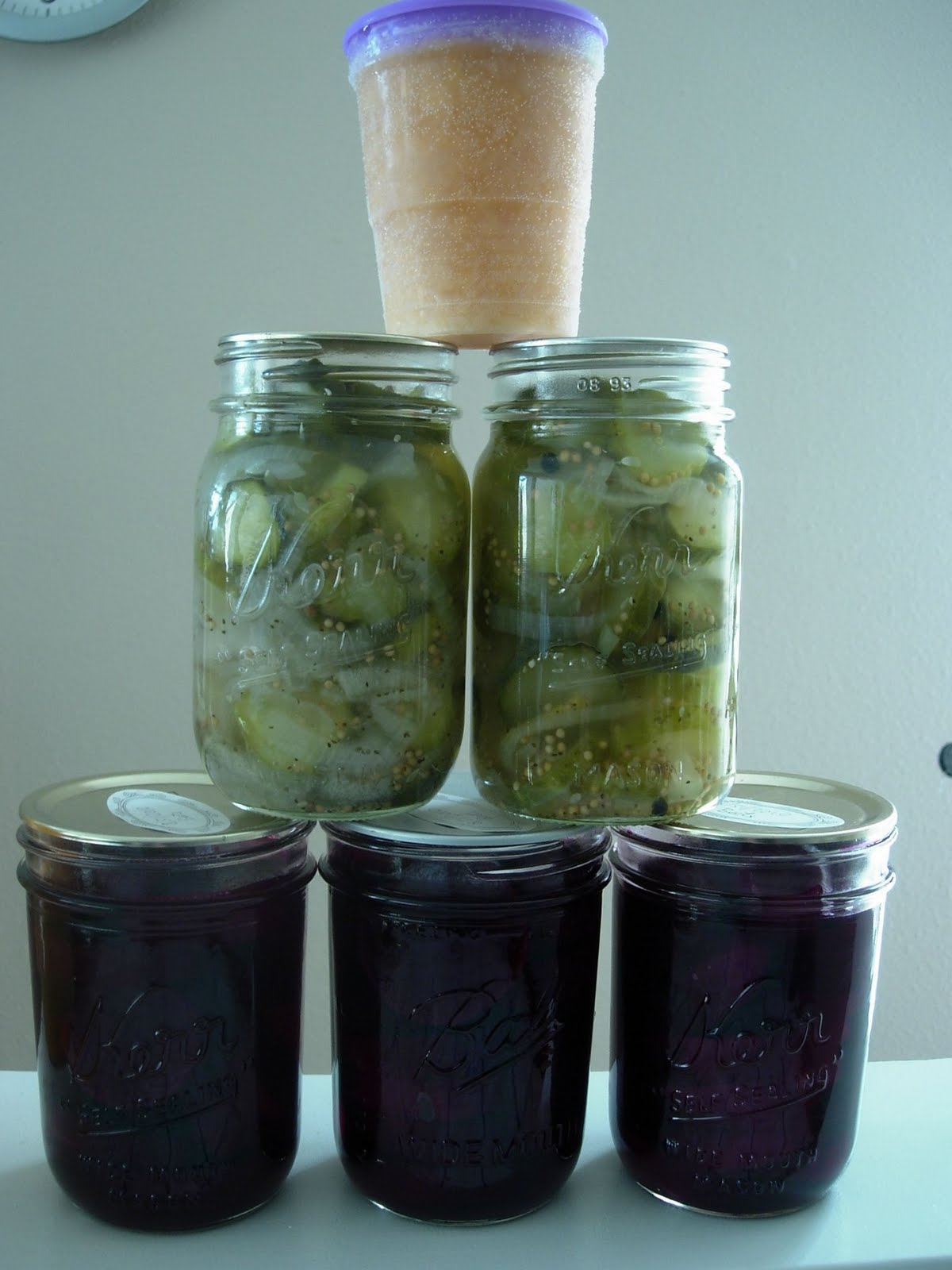
CAN

Behold this marvel of modern science!

These jars are filled with perishable food yet they do not rot. Or at least not yet. Canning is not scary and will not kill you, unless you can non-acidic food like (non-pickled) vegetables and they develop botulism. So refrain from doing that and don't be afraid.

On the bottom of the pyramid are pickled beets. In the next row are bread and butter pickles, which are sweet pickles with onions. At the top is a container of freezer jam, which I made from a twenty pound box of peaches. I cooked the fruit for a minute or two with a little bit of sugar, added some lemon juice, thickened it with freezer jam pectin, and then froze it. I also made six quarts of pear sauce with cinnamon. I have so far resisted the temptation to eat my winter rations, so I can't tell you how anything came out yet. But I'll report soon. Here's a closer look at the beets:

Tuesday, October 12, 2010

Julia Child's Leek and Potato Soup

How could I have missed it for so long! It's a recipe from Mastering the Art of French Cooking that isn't outdated (Aspics and Molds, 544-6), uses no extravagant ingredients (Foie Gras Stuffing with Prunes for Goose, 284), and does not involve cooking lettuce (Lettuce, Braised, 489). Also, it's the very first recipe in the book. It makes enough for 6-8 people, or for two people with some for the next day's lunch and some for the freezer. It's better on the second day. Julia Child calls for a bit of cream or butter, but I had some good milk in the fridge and used that instead with fine results. Julia Child also calls for peeling the potatoes, but that's just silly. Here's the basic recipe:

  • 1 pound potatoes, chopped
  • 1 pound thinly sliced leeks
  • 2 quarts water
  • 1 tbs. salt
  • 1/3 cup whole milk or cream

Simmer the vegetables, water, and salt together, partially covered, for 40 to 50 minutes. Mash the vegetables with a potato masher (or fork, or food mill); don't puree it. Immediately before serving, add the milk (or just add a tablespoon or so to each bowl).

The recipe also calls for parsley or chives added at the very end, which I would have done if I had either. My mother likes to put cilantro in her leek and potato soup, which I also endorse. Julia Child mentions that you can add carrots, turnips, tomatoes, half-cooked dried beans, peas, or lentils with their cooking liquid at the beginning. You can also add cauliflower, cucumbers, broccoli, Lima beans, peas, string beans, okra, zucchini, shredded lettuce (oops!), spinach, sorrel, or cabbage after the soup is mashed, to be cooked for 10 minutes or so. I made my batch with some carrots and parsnips, even though parsnips aren't on this list. Deviation from a Julia Child recipe usually leads to ruination, but I got away with this one.

Monday, September 20, 2010

Vancouver, Day 1, 9/15/2010

Lindsay and I hurried to King Street Station soon after her last prelim to catch the train to Vancouver. I called my father to wish him a happy birthday. We were in a celebratory mood, and once we got going we indulged ourselves with some $5.50 bottles of beer to go with our dinner of bread, baba ghanouj (leftover from our housewarming party), and Romano beans with tomato sauce, whose recipe follows:

  • 1 pound Romano beans, stem ends trimmed, cut in half so they're not so long
  • 2 pounds tomatoes
  • 5 cloves garlic, minced
  • lots of basil leaves, chopped
  • little splash of white wine
  • copious olive oil
  • salt, pepper

Heat the garlic in the olive oil in a large skillet or pot over medium-low heat while you prepare the beans. When you've finished cutting off their ends and chopping them up, toss them in the skillet with a bit of salt and pepper. Core the tomatoes and chop them roughly, putting them in a colander inside a mixing bowl and salting them lightly as you put them in, to help draw our their liquid. As you're preparing the tomatoes, periodically hold the colander over the pot of beans and push on the tomatoes to try to squeeze out as much liquid as possible. Turn the heat up on the beans to keep this liquid simmering. Keep pressing out as much liquid as can, and let this liquid reduce until it's a thick syrup (this will take a long time, especially if you use a narrow pot). At this point the Romano beans will be quite tender, but go ahead and add the wine and the diced tomatoes, and cook for another five minutes. Let this cool (or put the pot in a bowl of ice water if you need to go catch a train), adjust the seasoning, and add tons of chopped basil. Serve at room temperature.

Tuesday, September 07, 2010

Potato Roasting in Great Detail

After a pleasant visit from my parents with lots of exciting food, I made a very simple dinner of roast potatoes with pesto. The combination (born of a need to use up some basil) is good, but what I want to share is my current potato roasting technique. Everybody cooks this, so chime in if you've got a nice method. The basic summary of what I do: low heat until they're cooked through, high heat for ten minutes or so. It's not really worthy of being called a recipe, but if it makes my potatoes crunchier it's good for something.

  • potatoes in 1-inch chunks (or anything sized consistently)
  • olive oil
  • salt, pepper, rosemary

Put the potatoes in a large pan, or in multiple large pans, so that they're in a single layer and not completely packed up against each other. Mix them up with the oil, salt, pepper, and rosemary. Put in a 350 degree oven until the potatoes are soft. It's okay if they're not done to the point that you could eat them happily, but you should be able to eat them. This takes me 40-60 minutes, depending on the potatoes and the oven and mysterious forces (potatoes seem to cook faster in Lindsay's presence, for example). Ideally, try to scrape up all the potatoes from the pan every 15 minutes or so; a metal spatula works best. Turn the heat up to 450 and cook the potatoes until they're golden, which should take 10-15 minutes. Stir them once or twice and check on them when you do.

You can vary the seasoning and the fat. In the winter something like garam masala is nice instead of rosemary. Other pleasant fats include peanut oil, lard, and duck fat, and even a totally neutral oil like canola makes delicious potatoes. I would have thought that more oil meant crispier potatoes, but in my experience it hasn't been true. If the potatoes end up dried out, or if you're just in a hurry, try roasting at 375 and 475 instead of 350 and 450. You really can't go wrong whatever you do.

Saturday, September 04, 2010

Tomatillo Dressing

I have been cooking for myself for (almost exactly!) five years. Tomatillos only entered my kitchen about a month ago. The first thing I made was the green chile at my housewarming party. The second was a sauce that left my pasta looking totally bare, but which tasted fine, since tomatillos are amazingly concentrated. The most recent was a salad dressing to use up the three little leftover tomatillos. It's been a real Columbian explosion. For enough dressing for a salad for two to six people:

  • 3 (or fewer) little tomatillos
  • olive oil
  • honey
  • salt, pepper

Take the husks off the tomatillos and wash off their slimy skins (I have no idea if this is necessary). Put them in a 450 degree oven in a roasting pan and cook until they start getting charred on the top, about 10-15 minutes. When they're cool enough to handle, blend them up in some way. Or you could just mush them up; you'll get some chunks, but that's fine. Add a decent amount of olive oil and a dollop of honey (maybe a teaspoon, but any amount would be fine), and you will an excellent salad dressing. It's nice if the salad has cucumbers in it, like this one does:

A salad with cucumbers and tomatillo dressing.

If you were making a salad with, say, a vinaigrette, you probably wouldn't want to drench it in dressing. With this dressing feel free. Nothing bad will befall your lettuce.

Saturday, July 03, 2010

Quinoa and Tofu

Quinoa and tofu sounds like a parody of bad vegetarian food. Let us rescue it from the scourge of blandness by loading it up with all the new summer vegetables and seasoning heavily. Lindsay and I did this together, and out of it we got a terrific dinner, a few lunch portions, and the pleasure of using up some of our CSA vegetables (I'm talking about you, aging chard).

I used some dry, marinated tofu from our friendly local tofu factory. I marinated it some more anyway, so it seems reasonable to start with a typical block of tofu, press out as much liquid as possible, and then marinate that. It would be nice to serve this dish cold, but I didn't plan ahead, so I put it in a bowl in a bigger bowl of ice water to cool it down to room temperature quickly.

Pretty red and yellow tomatoes, no?

  • 1 cup (dry) quinoa
  • 3 blocks of dry tofu from Northwest Tofu, or most or all of a normal packet of tofu, in rough cubes
  • 2 large tomatoes, cut roughly into cubes
  • 1/2 cucumber, cut into cubes
  • 1 large spring onion (or normal onion), with green part (or with some scallions), chopped
  • 5 chard leaves, stems separated, coursely chopped
  • 1/2 lemon
  • 1 tbs. peanut oil
  • salt, pepper
  • marinade for tofu (see below)

For the marinade, you don't need to be at all precise, and I wasn't. Here's a very rough estimate, but substitute freely and use your own judgment:

  • 1/4 cup soy sauce
  • 2 tbs. peanut oil
  • 2 tbs. rice vinegar
  • 1 tbs. mirin
  • 1 tsp. sesame oil
  • lots of grated ginger
  • a bit of onion, minced finely
  • 1 clove green garlic (or normal garlic), minced finely
  • star anise, coriander, cardamom, or other spices of your choosing

Put the marinade over the tofu and let it sit out for an hour or so, giving it an occasional stir so that all of the tofu gets to spend some time immersed in liquid. Cook the quinoa with 2 cups water and some salt. Heat up the peanut oil over medium heat in a pan and cook the onion for a minute or two with a bit of salt so that it loses its edge but maintains its crunch. (I hope that as I age, I lose my edge but maintain my crunch.) Remove from heat into a large bowl. In the same pan, cook the chard stems, adding a bit of water, and after two minutes add the leaves and some salt, turn of the heat and give it a stir or two until the leaves wilt. Add to the bowl with the onions. Let these things cool or take action to make them do so. Then add the quinoa, the tofu with its marinade, the cucumber, the tomatoes, and the juice of a half lemon. Add some pepper, add more soy sauce or vinegar or whatever if necessary, and serve.

Tuesday, June 15, 2010

Sugar Snap Peas with Morels and Mint

Yesterday Lindsay and I cooked dinner for her mother: halibut with Chimichurri sauce, a lettuce and tomato salad with croutons flavored with oregano from Lindsay's yard, and the snap pea dish that gives this post its title. We didn't take a picture of the snap peas, so here's another fish picture to keep everyone satisfied:

Why didn't we take a picture? It's because the peas were the very last thing on the table, after the camera was put away. This was because I completely forgot about them until the fish was almost done. But there was no disaster, since this dish only takes about 10 minutes. All I did was take something that my mother cooks and make the Northwestern addition of morels. For a side dish for four people:

  • 1 pound sugar snap peas, tops and strings snapped off
  • 1/4 pound morels, chopped very coarsely
  • 5 mint leaves, minced or chiffonaded
  • 2 tsp. soy sauce
  • 2 tbs. peanut oil
  • 1 tsp. rice vinegar
  • salt, pepper

Heat a very large skillet over very high heat with 1 tbs. of the peanut oil. When it's really hot, add the peas and a sprinkle of salt and pepper and leave them alone for about a minute, until they've blistered and browned. Flip them over and cook them for another 30 seconds, giving them an occasional shake. Add 1 tsp. soy sauce, stir, and remove the peas to a serving dish. Put the pan back on the heat and cook the morels the exact same way (another tbs. of oil, another tsp. of soy sauce). Add the mushrooms to the serving dish. Add the rice vinegar, the mint, and a shake of coarse, crunchy salt if you have some.

Saturday, May 08, 2010

A Beet Primer, part 2: the nuts and beets of things

These recipes combine beets with nuts. I was planning to write some filler about how nuts and beets complement each other, but I don't really think they do. They're both earthy and almost dirty tasting. Sometimes there are more important things than balance!

Since the nuts will provide so much flavor, these are good recipes to use the easier but inferior method of beet cookery mentioned in my previous article, which I'll summarize:

If the beets are really dirty, rinse them a bit, but don't worry too much about it. Put them in a pan, tops cut off but otherwise whole and unpeeled, with a splash of water and a bit of salt. Cover and put in the oven at 400 degrees for about an hour, depending on the size of the beets. Pierce them with knife to check if they're done. You can put them in the fridge for later or use them right away. When you're ready, peel the beets by holding them under running water and sloughing off the skin. Then chop to desired size.

Here are the recipes. I'm leaving them imprecise because measuring when you make these would be like weighing your lettuce when you make a salad.

Beets with Pecans
  • cooked beets in 1-inch cubes
  • pecans
  • olive oil
  • rice vinegar
  • salt, pepper

Toast the pecans in a dry cast iron pan over medium heat, giving them an occasional shake. When they've browned a bit, combine them with the beets, pour on some oil, vinegar, salt and pepper, and toss. This is also good with a little bit of honey, especially if the beets aren't very sweet.

Beets with pistachios
  • beets
  • tahini sauce
  • pistachios

If you don't have any tahini sauce, make some. (I just mixed up some tahini paste with a clove of crushed garlic, some cumin, salt, tons of lemon juice, and some water to thin it.) Toast some (shelled!) pistachios, and combine with the beets and tahini dressing.

Arugula and Beet Salad with Pine Nuts
  • beets
  • arugula
  • pine nuts
  • lemon juice
  • olive oil
  • Parmesan cheese

Toast the pine nuts. Shake up lemon juice and olive oil in a jar, pour it over the beets, pine nuts, and arugula, and toss along with Parmesan. This one is nice with warm beets, so that the arugula wilts a bit.

Sunday, April 18, 2010

Chicken with Spices and Sweet Potatoes

I thought of this right before I fell asleep one night last week. I'd say it was of divine origin, but actually I got the idea from Bill Buford's book Heat, which talks about a pre-Columbian Italian recipe of meat cooked with sweet red wine, orange zest, and spices. Here I've taken this and adulterated it with some post-1492 tomatoes and sweet potatoes. The recipe is slow, but it's really simple. Brown the chicken, braise the chicken, and then when you're close to done, add some sweet potatoes and carrots.

  • 2 chicken legs, split into drumsticks and thighs
  • 1 large onion, chopped
  • half a 28oz can of tomatoes (or a smaller can), crushed
  • zest of an orange
  • 1 carrot, roughly chopped
  • 2 sweet potatoes, preferably the white kind, in 1-inch chunks
  • 1/2 cup red wine
  • 1 star anise
  • 3 cloves
  • 1 tsp. coriander
  • 1 heaping tsp. honey
  • 3 tbs. olive oil
  • salt, pepper

Sprinkle the chicken pieces with salt and pepper. In a large pot or dutch oven, heat up 2 tbs. oil over medium-high heat, and brown the chicken on both sides. When you're done with this, remove the chicken, turn the heat down and cook the onions for about ten minutes with another tablespoon of olive oil, stirring occasionally. Add the chicken back to the pot along with the orange zest, spices, tomato, wine, and some salt. Bring the heat back up to get this simmering, and then put a lid slightly ajar on top of the pot and turn the heat to low. (If you're using a dutch oven, you might try cooking this in the oven at maybe 300 or 325 degrees.) Cook for an hour, adding more wine if it needs it (though it probably won't). Add the honey, carrots, and sweet potatoes, and cook until these are tender, another 20-30 minutes. If the dish is still liquidy, remove the lid and turn the heat up to dry it up a bit. Serve with bread.

Wednesday, February 10, 2010

A Beet Primer, part 1

In part 1 of this series of survey articles on beets, we will discuss various methods of basic beet preparation and their advantages. In part 2, we will demonstrate how these methods can be applied to create dishes featuring beets. In part 3, we will discuss the concentration of measure phenomenon, which in its ubiquity surely relates to beets.

The different methods of beet preparation can be broken into three classes: boiling, steaming, and roasting. Another technique worthy of consideration is to leave the beets raw (which can be thought of as the empty preparation). This will be discussed in part 2, but for now we limit ourselves to the three aforementioned classes.

Let us focus our attention on each of these in turn. The most traditional method of boiling beets is to bring a pot of water to a boil, typically by use of a stove, and then to place the beets in the water until they are cooked through. Thus cooked, the beets can be used immediately or stored in the refrigerator for a week or so. A variant of this technique is to cook the beets in a flavorful broth, along with other ingredients, thereby making a soup. We will neglect the former of these techniques in our article, and we will delay our discussion of the latter until part 2.

Steaming can be done in several ways. The next two methods are often classified as roasting, but as neither of them caramelize the beets, it is more accurate to call them steaming. The simplest and most reliable is to put the beets whole and unpeeled in a roasting pan with a small amount (perhaps 1/4 cup) salted water, cover the pan, and cook at 400 degrees. If the beets are quite dirty, it is advisable to give them a quick wash. As they will later be peeled, it is not necessary to be thorough, but leaving them completely unwashed may impart a dirty flavor. Depending on their size, they will need to be cooked from 45 to 75 minutes, with 60 being typical.

Another method of steaming often found in the literature is to wrap each beet individually in aluminum foil and then to place these in a 400 degree oven. It is commonly asserted that this method minimizes work, as the beets can be stored still wrapped in their foil in the refrigerator. In practice, though, this method is more trouble than it is worth. Even though they will later be peeled, the beets must be scrubbed well or they taste dirty all the way through. Despite all the foil, they still need to be placed in a pan, since invariably they drip sticky beet juice (especially when you cut into them to see if they are done). If put in the refrigerator in the foil, they will drip and stain your lovely, clean refrigerator purple, and then you will leave it dirty for the next three months as you wait for a good time to clean it up, all the while infuriating your roommates. Clearly, this is a method best avoided.

Last, we discuss roasting. This differs from the other methods in that the beets must first be peeled and chopped. Then, they are placed in a roasting pan with some salt, pepper, and fat, typically olive oil. Herbs and spices may also be placed in the pan. The pan is then covered and placed in the oven for thirty minutes, after which the cover is removed and the beets are cooked for about twenty minutes longer. In this stage they must be stirred occasionally to prevent them from sticking to the pan and to ensure they brown evenly, and care must be taken that they do not burn.

Out of these methods, there are really only two worth considering: steaming in a covered pan and roasting. The first of these offers unparalleled ease, leaving you with enough time to prepare another dish or write a treatise on, say, the chopping of carrots. In particular, after the beets are cooked with this method, it is child's play to peel off their skin under cold running water. In terms of taste, this method falls short of roasting but still performs adequately. You would probably not want to eat the resulting beets plain (unless you are a real beet aficionado), but when combined with other ingredients and some sort of dressing, they suffice.

The roasting technique, on the other hand, is by far the most laborious. The beets must be peeled, chopped, and carefully washed. But it makes by far the most delicious beets. They brown, and their natural sugars turn into something complex and beguiling. Beets cooked in this way can always be used in place of steamed beets with better results, and they are also delicious eaten plain, perhaps with some rice. They are perhaps worse for storing in the fridge, as they are already chopped and hence don't keep as well. In addition, much of their toasty flavor is diminished when cold.

Thus ends part 1 of our article on beet cookery. To summarize, the steaming method is the least work and it gives good results. Much time can be saved by cooking a large batch of beets in this manner and storing them in the refrigerator for later use. The roasting method is the most work, but it offers powerful deliciousness. In part 2, we will give ideas for what to do with beets cooked in these ways, as well as offer up some recipes that avoid such methods of beet cookery entirely. Stay tuned for more excitement.

Sunday, November 29, 2009

Soba Noodles and Squash

Soba noodles are great. Compared to normal pasta, they cook faster, have more taste, and cost about the same. You should be alert when you cook them. They're done more quickly than you'd think, and they're nicest when they're still chewy. This recipe takes 30 or 40 minutes, but it's incredibly simple. It serves 3 or 4 people.

  • 1/2 pound soba noodles
  • 1 large or 2 small delicata squash, chopped into 1-inch pieces and seeds removed (don't peel it, though)
  • 5 large collard leaves, chopped
  • 3 chilies of a level of spiciness that you like, finely minced
  • 1 clove garlic, crushed
  • 3 tbs. soy sauce
  • 2 tbs. mirin
  • 1/2 tsp. sesame oil
  • juice of 1/2 lemon
  • 1 tsp. rice vinegar
  • 2 tbs. peanut oil
  • 1 tbs. grated ginger
  • pepper

Put a pot of salted water on. While it comes to a boil, mix together in a large bowl all the ingredients but the noodles, squash, and collards. When the water boils, cook the soba noodles till they're done, about four or five minutes. Drain them and put them in the bowl, and stir them up.

Meanwhile, start steaming the squash. About 10 minutes later, start steaming the collards as well. When they're both tender, add them to the bowl. Mix and adjust the seasoning.

Friday, November 27, 2009

Kale or Collards with Peanuts and Garlic

As promised, here's another recipe for greens. Lindsay and I adapted the recipe from Simply in Season, a Mennonite cookbook, and we spiffed it up by adding chili-garlic sauce, soy sauce, and vinegar. Two people could eat this as meal, along with some rice. It could serve twice as many people as a side dish. It takes about thirty minutes to cook.

  • 1 bunch kale or collards (about 10 giant leaves)
  • 1 large onion, roughly chopped
  • 3 cloves garlic, diced or crushed
  • 1 tbs. peanut oil
  • 2 tsps. whole cumin seeds (or a smaller amount of ground cumin)
  • 1 tsp. ground coriander
  • 1/4 tsp. ground cardamom
  • 1 tbs. chili-garlic sauce, such as Huy Fong's (or just use fresh or dried chilies)
  • a bit less than 1/4 cup peanut butter, possibly more
  • 2 tbs. soy sauce
  • 1 tbs. rice vinegar
  • 1 tsp. sugar
  • salt, pepper

Cut the stems out of the greens and chop them roughly. Heat the peanut oil over medium heat in a big skillet than can be covered, and add the stems, the chopped onion, and some salt. Let this cook while you prepare the rest of the ingredients, stirring occasionally to keep things from burning. Chop the rest of the greens roughly. Mix up the peanut butter, soy sauce, rice vinegar, and sugar, along with about two tablespoons of water to thin it out (but don't worry if it's still thick--when it gets hot, it will unclump).

When the onions have browned a little, turn down the heat to medium-low and add the garlic, cumin, cardamom, and coriander. Cook this for about a minute, stirring, and add the greens, the chili-garlic sauce, and a bit more salt. Add about 1/4 cup of water, turn up the heat and stir this up. Once the water boils, turn the heat to low and cover, maintaining a simmer. Cook until the greens are tender, about 5-10 minutes for kale and 10-15 minutes for collards. Uncover and add the peanut sauce. Stir it until it heats up and coats the leaves. Add a little bit more water if it's stubborn. Taste it; add some more peanut butter, depending on what you think. Grind some pepper over the whole thing, and add some salt if it needs it.

Thursday, November 19, 2009

Barely Cooked Chard with Lemon and Parmesan

This year my CSA has loaded up my box with greens. Few can match me in my love for spinach, chard, kale, and collards, so it means something that I had so much of them that eating them was a burden. I've picked up some new tricks for greens, now. This was one of my favorites. Its basic outline--greens with olive oil and lemon juice--is unremarkable, but as always, adding a ton of Parmesan cheese makes it great. This also straddles the line nicely between cooked and raw. It's more substantial than a salad, but it's still as refreshing as one. It serves two and is really quick.

  • 5 large chard leaves
  • 1 or 2 large cloves garlic, julienned
  • 2 tbs. pine nuts (optional)
  • juice of 1/2 lemon
  • Parmesan cheese
  • olive oil, salt, pepper

Cut out the stems from the chard and cut them into inch-long pieces. Start this cooking in a bit of olive oil (use as little as possible--you'll be adding more) in a big pan over medium heat. Add the garlic, pine nuts, and a bit of salt, and give this a stir from time to time as you prepare the rest of the dish.

In a jar (or a bowl), combine the lemon juice with equally much olive oil. Grind in some pepper and add in lots of Parmesan cheese. Shake this up.

Cut up the chard and add it to the pan, along with some salt (greens need a lot of salt!). Stir for about thirty seconds. The goal is to stop cooking the chard at the first sign of wilting; remember that it will keep on cooking after you remove it, so err on the side of taking it out too soon. Remove everything into a large bowl, pour the dressing over, and toss.

Wednesday, June 17, 2009

Asparagus with Rice

I was embarrassed to post this recipe because there's so little too it. But what's wrong with that if it tastes good? I used lime juice when you'd expect lemon because I had a large bag of limes in the fridge, and I thought it worked well.

  • 1 pound of asparagus, trimmed of woody stalks and cut into one inch pieces
  • 2 large onions, chopped roughly
  • 1/2 of a lime
  • 1 tbs. olive oil
  • salt, pepper

Cook the onions in a large skillet with the oil over medium heat, stirring often. Add salt. Cook for about twenty minutes, until the onions are nicely browned (but feel free to cut this short if you're in a hurry). Add about 2 tablespoons of water to the pan. Stir this around quickly, scraping the pan to free any nice, brown oniony bits. Shake a bit of salt in, add the asparagus, cover, and turn the heat to medium-low. Cook for a few minutes, until the asparagus is nearly cooked to the point you like. Uncover, turn the heat up a bit, and try to get some brown on the asparagus. Add lots of pepper, salt if necessary. Squeeze the lime over this, mix, and remove from the heat. Serve with rice; about 1/2 cup dry rice makes a good amount to go with this. Serves 2-4, depending on what else you're eating.

Friday, January 02, 2009

Pumpkin Lasagna

Ever since I started cooking I've eaten a lot of squash, which confuses my parents since they never cooked them when I was growing up. (Squash is my form of rebellion.) In Seattle I've met lots of new squashes, like the delicata, which is my favorite for its creamy, dense, sweet flesh. But this post is about the pumpkin, and the lasagna that Lindsay and I made from one. I used Mark Bittman recipes for the pasta and the Béchamel sauce.

The pasta:
  • 1/2 pound spinach
  • 2 1/2 cups flour
  • 1 tsp. salt
  • 3 eggs

Put the spinach in boiling water and cook it till it wilts (about a minute and half). Run cold water over it to cool it down. Pick it up and try to squeeze all the water out of it. Then chop very finely, or put it in a food-processor and puree it.

Mix up the flour and salt in a large bowl. Crack an egg and mix it in. Add some spinach. Repeat with the other eggs, incorporating the spinach as you go. Once you've added all the eggs and spinach, try to form a ball of dough, adding a little bit of water if necessary (it almost certainly will be, but you'll probably only need a tablespoon or two). Once you've gotten the dough together, roll it out as thinly as possible, and cut into appropriate strips for lasagna.

The Béchamel sauce:

  • 1 1/2 tbs. butter
  • 1 1/2 tbs. flour
  • 1 1/2 cup whole milk

Heat the butter in a small pot. When it's done foaming up, add the flour and cook over low heat, whisking. When the flour is light-brown, start adding the milk gradually. Whenever the sauce looks thick, add some more milk, stirring with a wooden spoon the whole time and making sure to scrape the bottom of the pan. You can turn the heat up a little bit while you do this. After 15-30 minutes, you should have a thick sauce, and you're done.

Everything else:

  • 1 medium-sized pumpkin
  • 1 pound of mushrooms (we used hedgehogs and black trumpets)
  • 1 1/2 cups grated Parmesan cheese
  • 1 tbs. butter, plus a bit more for greasing the pan
  • 1 tbs. olive oil
  • salt, pepper, nutmeg

Cut the pumpkin in half, take out the seeds, and roast at 375 degrees till it's very soft, about 1 1/2 hours. Scoop out the flesh and season it with salt, pepper, and nutmeg.

Cook the mushrooms in the butter and olive oil over medium heat with some salt and pepper. Cook until all of the exuded mushroom water has evaporated, and then let the mushrooms brown a little bit.

Boil water and cook your pasta for a minute or two.

At this point, everything is prepared and you just need to assemble the lasagna. Preheat the oven to 400 degrees. Grease a pan with butter and put strips of pasta on the bottom of the pan. It's okay if they overlap a bit (or if they don't). Put down a layer of pumpkin, a layer of mushrooms, a layer of Béchamel, and a layer of cheese. Put down another layer of noodles and repeat the whole thing two or three times. End with a layer of pasta, Béchamel, and Parmesan. Bake this for thirty minutes (or until it starts to bubble). Let it rest for at least 10 minutes, and serve.

Here's the first layer of the lasagna:

And this is what it looked like after it was cooked:

Thanks to Lindsay for the pictures.