Sunday, April 17, 2011

Burnt Greens

Last Thursday, I went to Revel with my cousin Amelia and ate what amounted to a broiled salad. It was a mixture of lettuces and other greens, blackened on top and raw on the bottom, and it was very good. I don't think I can reproduce it, but yesterday I made something similar. I used kale raab (kale that had started to flower). I think any tough green like kale, chard, or collards would work fine.

  • 1/2 pound bunch of kale raab
  • 1 tbs. peanut oil
  • 1 tbs. fish sauce
  • 1 tbs. garlic-chili paste
  • 1 tbs. fermented plum paste, or fermented soy paste, or soy sauce
  • 1 tbs. rice vinegar
  • 2 tsp. sugar
  • 1 tbs. water

Mix together all the ingredients besides the greens and the peanut oil. Blanche the greens for about five minutes (less if they're young and tender) in boiling water. Drain and run cold water over them to stop the cooking. Lightly squeeze the greens to remove water and lay them out in an inch-thick layer on a baking sheet. Dry the top of this with a cloth or paper towel as best you can, and drizzle the peanut oil on it. Put the greens right under a preheated broiler. Take them out after about five minutes, when they've just started to burn at the tips. Put in a bowl and toss with the sauce.

Burnt greens.


A bulb growing in our planter.

Saturday, April 09, 2011

Hummus Variant

Tonight for dinner I made hummus, and it only took me about an hour. I took my favorite hummus recipe, replaced the slowest cooking beans (chickpeas) with the quickest (black-eyed peas), and also threw in some leeks, because I've always wanted to put leeks in hummus. The results were pretty good. Nobody who ate it would bat an eye, but once you know it's not made with chickpeas, you'll notice the slight vegetal flavor of the peas. Or maybe that was just the leeks. Either way, I liked it.

  • 1 cup black-eyed peas
  • 1 large leek, cleaned and chopped
  • 1/2 cup tahini
  • juice of 1 1/2 lemons, or more
  • 3 cloves garlic
  • olive oil, salt

Cook the black-eyed peas in water to cover with about 1/2 tsp. of salt. You want to get them completely tender. Mine took about 45 minutes, but beans vary. While they cook, sauté the leeks in oil slowly with a bit of salt, stirring occasionally, until they've browned a bit. When the back-eyed peas are almost done, add the leeks to the pot with them.

Leeks and black-eyed peas cooking. Despite the picture, cover the pot of black-eyed peas.

In a food processor (or with an immersion blender, which is what I used), puree the garlic with the lemon juice, tahini, and 1/4 cup of water (use extra water from the beans if there's any). Add the black-eyed peas and the leeks and puree some more. Add olive oil to taste (I like about 1 tbs.), and puree some more. Add salt and more lemon juice if necessary.

More Home Improvement

When I was in New York a few weeks ago, I packed up 45 pounds of CDs and books of mine that were cluttering up my parents' house and mailed them to Seattle. Soon, they were cluttering up my apartment, and Lindsay and I set out to do something about it.

We went to the hardware store, bought some standard shelves and supports, found studs in our wall, and put everything up. The shelves look nice, and they feel sturdy. Success!

Me and Lindsay looking unusually glamorous in New York.

Sunday, March 13, 2011

A Fine Wallingford Day

New York next week! Here are some Wallingford photos in case I miss it while I'm there. These discs remind me of grape-flavored children's tylenol.

Weird stone discs

Somersaulter in Gasworks Park

Racking

Last week I racked my honey wine from one carboy to another, thereby achieving my goal of combining common words like rack, car, and boy into an incoherent jumble. A carboy is a jug, and racking is the process of siphoning a fermented liquid from one jug to another, leaving the yeasty sediments behind.

The original carboy.

The happy racker.

I made the honey wine as instructed by Sandor Ellix Katz in Wild Fermentation, which means it's as simple as possible: mix honey and water, let it sit around for a few days until yeast colonize it, and put it in a carboy capped with an airlock, which lets gas escape but not enter. I started it in September, and I flavored it with a little bit of mint from the patch on our sidewalk.

Racking is fun; a few pumps on the Auto Siphon (or L'auto-Siphon--the instructions were in English and French) and you're enjoying the alchemy of liquid flowing through tubes.

A glass of honey wine, with the new carboy behind it.

The honey wine is still a little sweet, though in a pleasant way. It's developed a slightly rubbery flavor; it's not terrible, but I'm still hoping it goes away. Maybe in another six months?

Monday, February 21, 2011

Long Weekend

This weekend Lindsay and I had our advisors and their spouses over for dinner.

A striking squash.

Spinach pasta.

The main course.

We made squash lasagna, roasted cauliflower with hazelnuts, sauerkraut, and brownies. Our guests brought wonderful wine. A good time was had by all. Also, it was my brother's birthday! Happy birthday, Seth.

On Sunday Lindsay and I biked to Capitol Hill, making use of these new buffered bike lanes, and I got a haircut. I went to the Elliott Bay Bookstore and bought Canning for a New Generation. It's a beautiful, encouraging book. Here it is on typical canning books:

[I] found that the common thread running through them all, from the classic Ball Blue Book to the newer, prettier books on jam and jellies, is the notion that Canning Is Hard: tedious work, complicated, deadly. I somehow got the impression that I would die if I tried this without three thermometers calibrated monthly, a hundred-foot roll of litmus paper, and a topographical map that pinpointed my location and its exact elevation.

I once read a book on canning that advised its readers to boil their canned food for ten minutes immediately before eating it, in case it had developed botulism. This sounded impractical if I just wanted some jam in the morning.

Then we got completely lost trying to get to the arboretum and went home, where I discovered that pages 148-161 were torn out of my new book. But still, it was a very nice day.

Those pages must have had some good recipes.

On Monday, I ate dutch babies, did math, and ate fresh pasta with tomato sauce. (When you borrow a pasta maker, you should use it! Thanks to Chris and Nathalie for lending it to us.) I also ate some apple-walnut cake, the subject of a future post. If every weekend was like this I would be very happy.

Dutch Babies

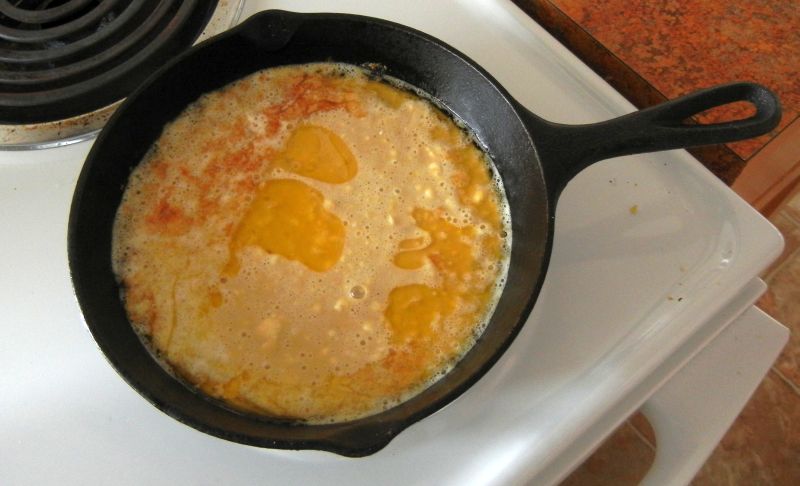
Dutch babies are massive pancakes that puff up in the oven and deflate when you take them out. They're eggy like clafoutis or kaiserschmarrn. I halved this recipe (another fine product of Paprika), and the batter fit in an 8-inch cast iron pan. Here's the dutch baby about to enter the oven:

And here it is when we took it out 25 minutes later:

I wasn't quick enough to take a picture of it still puffed up, so just try to imagine me pulling it out of the oven with the center even higher than the edges. This lasts a few seconds; then the center trembles and falls in. The edges end up crunchy, and the middle is soft and custardy. We ate it with lemon juice and powdered sugar.